Let's Get Your Project Moving

Request a detailed pricing estimate or consult with our specialists to map out your requirements.

OR
Edit Template
Home / Resources / FAQ’S About In-Circuit Test Fixtures

FAQ'S About
In-Circuit Test Fixtures

In-Circuit Test (ICT) fixtures serve as high-precision electro-mechanical interfaces in modern PCBA manufacturing, establishing reliable connections between individual circuit nodes and Automated Test Equipment (ATE).

In Circuit Test Fixtures 06
Understanding In-Circuit Test (ICT) Fixtures

In modern electronics manufacturing, verifying the structural integrity and electrical functionality of printed circuit board assemblies (PCBAs) is essential for maintaining product quality. In-Circuit Testing (ICT) provides one of the most reliable methods for board-level validation, operating through custom-engineered ICT test fixtures. Whether your process requires vacuum actuation, pneumatic systems, manual mechanisms, or high-density bed-of-nails configurations, selecting the correct interface directly impacts test speed and fault coverage. Fixtronic explores the operational principles, structural designs, and strategic applications of ICT fixtures to help you choose the ideal setup for your production line.

As a specialized engineering and test fixture provider, Fixtronic delivers high-precision, custom-built test interfaces engineered for high-volume manufacturing environments. This technical guide outlines the core types, mechanics, and operational advantages of modern ICT fixtures, assisting engineers, quality managers, and procurement teams in optimizing their board-level testing processes.

In-Circuit Test (ICT) fixtures are high-precision mechanical interfaces engineered to securely hold and connect a Printed Circuit Board Assembly (PCBA) to an Automated Test System during the manufacturing process. By deploying a custom matrix of spring-loaded test probes (pogo pins), these fixtures establish direct electrical contact with designated test pads across the board layout. This direct interface enables automated detection of critical assembly defects, including open circuits, solder bridges, missing or reversed components, and out-of-tolerance passive values. By capturing structural faults immediately after Surface Mount Technology (SMT) line processing, manufacturers prevent defective boards from advancing to final assembly.

The strategic value of an ICT fixture stems from its ability to deliver accurate, repeatable, and automated testing across low-, medium-, and high-volume production runs. Without a dedicated, custom-engineered fixture, achieving precise probe alignment on micro-scale test pads is impossible, resulting in unreliable test coverage, false failures, and undetected field defects. By implementing custom Fixtronic ICT fixtures, manufacturers reduce overall production costs, minimize rework cycles, and maintain strict quality control standards throughout the manufacturing lifecycle.

In-Circuit Test (ICT) fixtures are available in distinct mechanical configurations, each engineered to align with specific production volumes, PCBA layout complexities, and operational budgets. Below is a detailed breakdown of the primary fixture mechanics—vacuum, pneumatic, and manual—along with their specific engineering features.

Vacuum ICT Fixtures

Vacuum ICT fixtures utilize atmospheric suction to pull the PCBA down onto the probe field, establishing precise contact between the test pads and spring-loaded pogo pins. This design is widely deployed in high-volume, continuous manufacturing environments where rapid cycle times and repeatable probe contact are mandatory.

  • High-Density Probing

    Excellent for complex, multi-layer assemblies with high test-point density.

  • Dual-Side Access

    Highly effective for simultaneous top-and-bottom side probing, allowing complete board coverage in a single actuation cycle.

  • Fast Cycle Times

    Enables rapid testing sequences, with typical test execution completing within 15 to 25 seconds on high-density assemblies containing thousands of test points.

Pneumatic ICT Fixtures

Pneumatic ICT fixtures employ compressed air cylinders to drive the press-plate down, forcing the board evenly against the spring probe matrix. Engineered for semi-automated and fully automated production lines, pneumatic setups excel in medium- to high-volume runs where high force and strict repeatability are required.

  • Uniform Pressure Distribution

    Delivers consistent mechanical force across the entire board surface, maintaining reliable probe contact even on slightly warped or uneven substrates.

  • High Pin-Count Capacity

    Handles high overall probe forces effortless through adjustable cylinder pressure, typically operating within a 1.5 to 6 bar range.

  • Versatile Customization

    Easily configured with targeted stroke controls to accommodate diverse PCBA geometries and component clearance heights.

Manual ICT Fixtures (Mechanical)

For low-volume production runs, high-mix batches, or early-stage prototyping, manual ICT fixtures provide a straightforward, cost-effective interface. An operator manually inserts the PCBA into the gate and engages a mechanical lever, toggle clamp, or drop-down lid to press the board onto the spring probes.

  • Cost-Effective Tooling

    Significantly lower initial capital outlay compared to automated actuation systems, making them ideal for initial NPI phases or small-scale operations.

  • Operational Flexibility

    Simple mechanical design allows for fast setup, low maintenance, and quick board turnarounds.

  • Ideal for R&D and NPI

    Performs reliably during prototype testing and low-volume production where automated throughput speeds are not critical.

Within the domain of In-Circuit Testing, bed-of-nails fixtures represent one of the most widely deployed and dependable test interfaces. These fixtures utilize a dedicated grid of spring-loaded pogo pins (the “nails”) that align with targeted test pads across the PCBA. This structural design guarantees exact pin registration and stable, low-resistance electrical contact throughout the test cycle.

Bed-of-nails fixtures are manufactured in several key configurations to accommodate varying PCBA architectures, board densities, and signal integrity demands:

Single-Sided Bed-of-Nails Fixtures

Designed to access test points on a single surface of the PCBA (typically the bottom layer), single-sided fixtures are ideal for boards with all designated test nodes located on one plane.

  • Simplified Tooling

    Streamlined mechanical layout reduces design lead times and manufacturing costs.

  • Cost-Effective Integration

    Commonly paired with manual or entry-level pneumatic press units for straightforward, reliable testing.

Double-Sided (Clamshell) Bed-of-Nails Fixtures

For complex PCBA layouts featuring components and test pads on both top and bottom layers, double-sided bed-of-nails fixtures provide dual-access probing.

  • Simultaneous Top/Bottom Access

    Engages both sides of the board in a single press cycle, eliminating the need for multi-stage flips or separate test passes.

  • Balanced Force Distribution

    Frequently integrated with vacuum or pneumatic actuation to maintain even probe contact across high pin-count double-sided layouts.

Wireless Bed-of-Nails Fixtures

Traditional fixtures rely on dense point-to-point wiring harnesses between spring probes and the system interface board. Wireless fixtures replace wire bundles with a custom multi-layer transfer PCB (or translator board) to route signals directly.

  • Enhanced Signal Integrity

    Shortens signal paths and minimizes crosstalk, making it well-suited for high-frequency, high-density testing applications.

  • Streamlined Maintenance

    Eliminates wire clutter, significantly simplifying troubleshooting, pin replacement, and long-term fixture servicing.

Understanding the practical applications of In-Circuit Test (ICT) fixtures is key to optimizing production lines and ensuring long-term product reliability. These fixtures serve as critical quality control checkpoints across various manufacturing phases, offering distinct operational benefits:

Quality Control in High-Volume SMT Production

In continuous, high-volume production, ICT fixtures rapidly detect structural manufacturing defects such as solder bridges, open circuits, and misplaced components. Vacuum and pneumatic fixtures are heavily utilized here for their high-speed, repeatable operation—enabling automated lines to process hundreds of assemblies per hour while maintaining exceptional fault coverage before boards advance to functional testing or end-of-line packaging.

Prototype Validation and NPI (New Product Introduction)

During early product development, manual ICT fixtures provide an agile, cost-effective method for verifying initial PCB designs. Engineers and R&D teams can perform board-level diagnostics on small batch runs without committing early capital to automated tooling, allowing rapid iterative adjustments prior to full-scale mass production.

Double-Sided PCBA Testing

For high-density board layouts featuring active and passive components on both layers, double-sided (clamshell) bed-of-nails fixtures are essential. These setups engage top and bottom test pads simultaneously in a single test pass, providing comprehensive fault detection without increasing cycle times—a necessity in demanding fields like automotive control units, telecommunications, and aerospace electronics.

Parametric and Component-Level Diagnostics

ICT fixtures enable direct, parametric measurement of discrete components prior to powering up the board. By verifying passive values—such as precise resistance, capacitance, and inductance—and checking diode orientations or IC pin continuity, Fixtronic test fixtures identify defective or out-of-spec components early, preventing potential cascading failures during later system-level testing.

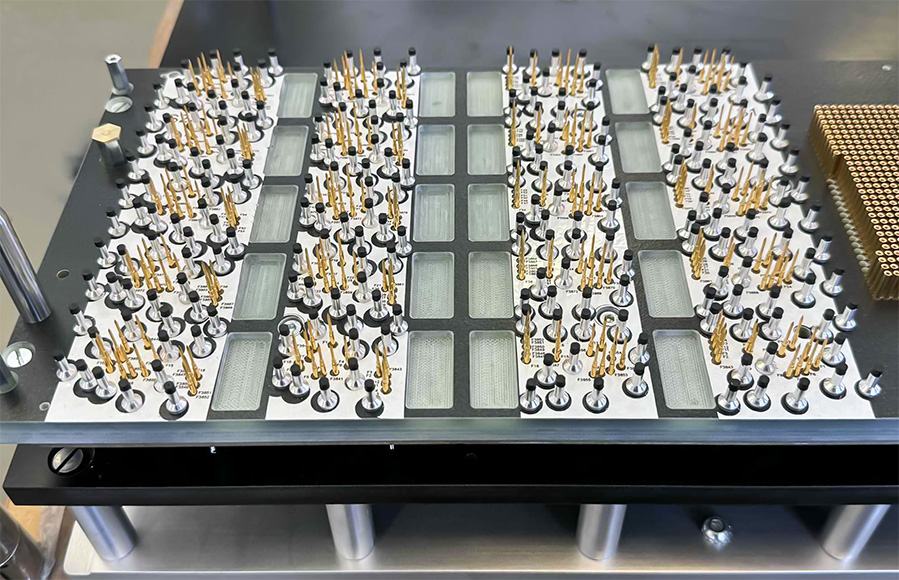
Selecting the optimal ICT test fixture requires balancing production throughput requirements, PCBA density, and long-term capital allocation. Key engineering and operational considerations include:

  • Production Volume & Throughput

    High-volume SMT lines require vacuum or pneumatic ICT fixtures to maximize test speed and ensure automated repeatability. Low-volume batches, high-mix runs, or NPI testing are typically best served by cost-effective manual fixtures.

  • PCBA Layout & Component Density

    High-density boards and complex designs with test pads on both surfaces demand double-sided (clamshell) bed-of-nails configurations or wireless fixtures to guarantee total test point coverage and high signal integrity.

  • Operational Budget & ROI

    Manual fixtures minimize upfront capital expenditures for short runs or early-stage development, whereas automated pneumatic or vacuum Fixtronic systems deliver lower per-unit test costs and reduced labor overhead in continuous mass production.

  • Test Cell Architecture (Inline vs. Offline)

    The choice of fixture depends on whether testing is integrated directly into an automated inline conveyor belt setup or performed at a standalone offline testing station.

Implementing Fixtronic In-Circuit Test (ICT) fixtures into your production workflow delivers substantial operational benefits that extend far beyond baseline defect identification:

  • High Test Accuracy & Precision Registration

    Custom-engineered probing mechanisms ensure exact alignment with micro-scale test pads, eliminating contact failure and delivering pin-point fault isolation.

  • Optimized Cycle Times

    Automated vacuum and pneumatic fixture architectures drastically reduce overall test durations, completing comprehensive, multi-point board scans within seconds.

  • Substantial Cost Avoidance

    Identifying component-level defects immediately post-SMT prevents down-line board failures, eliminating expensive manual rework, scrap rates, and potential warranty recalls.

  • Scalable Production Integration

    From low-volume manual units to fully automated inline setups, ICT fixtures offer a modular testing path that effortlessly scales alongside rising manufacturing volumes.

Integrating In-Circuit Test (ICT) fixtures into your production environment brings high-efficiency quality control, but managing these systems involves navigating specific operational and technical demands. Here is how common implementation challenges are effectively addressed:

  • Challenge: Fixture Wear & Mechanical Degradation

    Operational Impact: Spring-loaded pogo pins undergo continuous compression stress, which can lead to tip wear, debris accumulation, or inconsistent electrical contact over thousands of test passes.
    Engineering Solution: Implement a scheduled preventative maintenance program. Routine cleaning and planned probe replacement (typically benchmarked between 50,000 and 100,000 actuation cycles) maintain low contact resistance and ensure consistent test accuracy.

  • Challenge: High-Density & Fine-Pitch PCBA Layouts

    Operational Impact: Modern, compact electronics feature dense component placement and micro-sized test targets, making mechanical probing difficult without specialized tooling.
    Engineering Solution: Utilize custom-engineered Fixtronic fixtures equipped with high-precision CNC guide plates and micro-pitch spring probes (down to 0.5 mm center-to-center pitch) to guarantee target registration on tight layouts.

  • Challenge: Initial Tooling Investment

    Operational Impact: High-performance automated or semi-automated test fixtures require dedicated upfront capital allocation compared to simple visual inspections or manual checks.
    Engineering Solution: Focus on total cost of ownership (TCO). Automated Fixtronic fixtures significantly shorten test cycle times, reduce operator labor, and eliminate costly post-assembly rework—delivering a rapid return on investment (ROI) across medium- to high-volume production runs.

We combine state-of-the-art manufacturing with stringent quality control to ensure smooth test operations, zero false failures, and maximum uptime. By offering our custom engineering solutions at competitive prices and with rapid lead times, we provide the reliable testing infrastructure you need to scale production without compromising your schedule or bottom line.

Partner with us to scale your products with confidence, knowing your testing infrastructure is built to perform.

Customer Support

Satisfaction Guarantee

Copyright © 2026 Fixtronic